


Presidential Address
The Power of History: The Weakness of a Profession
Over the past thirty years, historians have seen their job prospects shrink and their job security erode. Both the sales of scholarly history books and the number of undergraduate history majors have fallen. But in his presidential address to the Organization of American Historians, sees reasons for hope and spurs to action. He celebrates the unprecedented variety of innovative scholarship and the growing public interest in history. He urges history departments to cut back production of new doctorates and reliance on adjunct instructors. He urges professional groups to work with such natural allies as community college and high school teachers in joint efforts to revitalize teaching and broaden the audience for history. (pp. 1299–1314) Read online >
Articles
Empires, Exceptions, and Anglo-Saxons: Race and Rule between the British and United States Empires, 1880–1910
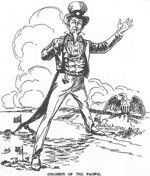
explores the dialogue between Americans and Britons on the meanings of race, empire, and national exceptionalism at the turn of the twentieth century. At a decisive moment, he argues, American colonialists successfully justified the annexation of the Philippines by an appeal to Anglo-Saxon racial exceptionalism. Reclaiming their ties to the British Empire through blood, culture, and history, American imperialists pronounced the nation both bound and fit to acquire an overseas colonial empire. By 1902, however, the rhetoric of American exceptionalism eclipsed the racial appeal, as Americans trumpeted their alleged republican mission to govern “dependencies” in a selfless spirit and with a promise of eventual self-government. (pp. 1315–53) Read online >
Special Online Feature: Kramer’s article is the featured article for the third installment of “Teaching the JAH” web project.
The Only Badge Needed Is Your Patriotic Fervor: Vigilance, Coercion, and the Law in World War I America
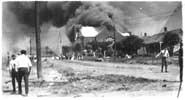
As the United States mobilized for World War I, the government looked to voluntary associations to safeguard American communities from foreign invasion and domestic subversion. The officials who urged grass-roots groups to police their neighbors distinguished between “vigilance,” endorsed as a democratic duty, and “vigilantism,” denounced as mob violence. In the article that won the Louis Pelzer Award for 2001, shows that in practice—in extralegal coercion of workers, women suspected of prostitution, and African Americans—vigilance and vigilantism mingled. His work raises questions about ideals of active citizenship, links between voluntarism and political violence in American history, and contemporary assumptions that voluntary associations contribute positively to civic identity and democratic engagement. (pp. 1354–82) Read online >
Ethnics against Ethnicity: European Immigrants and Foreign-Language Instruction, 1890–1940
Why did European immigrants decline to study their “native” languages in American public schools during the first half of the twentieth century? The standard historical interpretation stresses the coercive waves of Americanization that dampened linguistic diversity throughout the land. Yet, as shows, urban schools continued to offer Polish, Hebrew, Norwegian, and a host of other immigrant tongues. Promoted by ethnic leaders, the courses taught “pure” languages that differed sharply from the regional or mixed dialects that most newcomers actually spoke. By refusing to register their children for classes in their supposedly ancestral tongues, immigrants registered their hostility to uniform ethnic identities. Across a wide range of languages, they expressed their ethnicity—like their Americanism—in their own terms. (pp. 1383–1404) Read online >
The Great Society after Johnson: The Case of Bilingual Education
explores the tenacity of the liberal reformist impulse that created the Great Society. Most historians see the mid-1960s as the crest of that impulse, but Davies contends that a second peak occurred within government agencies during Richard M. Nixon’s first term. Latinos were among the groups who received increased attention from the federal government during the second phase of the Great Society. Davies uses the rise of the bilingual education program to illustrate how executive concerns, pressure group politics, bureaucratic entrepreneurship, and judicial activism combined to advance the cause of “language minorities” during the Nixon administration. (pp. 1405–29) Read online >
Exhibition Reviews
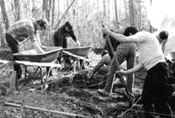
- “Editors’ Introduction: Teaching outside the Box,” by Gary J. Kornblith and Carol Lasser (pp. 1430) Read online >
- “Re-Visioning Women’s History through Service Learning,” by Catherine Badura (pp. 1431–34) Read online >
- “Exploring the Wide World of Sports: Taking a Class to the (Virtual) Olympics,” by Amy Bass (pp. 1435–39) Read online >
- “‘It Was As If We Were Never There’: Recovering Detroit’s Past for History and Theater,” by Charles Bright (pp. 1440–45) Read online >
- “‘Bringing History to Life’: Oral History, Community Research, and Multiple Levels of Learning,” by A. Glenn Crothers (pp. 1446–50) Read online >
- “Going Public with Introductory American History,” by John J. Grabowski (pp. 1451–55) Read online >
- “La Castaña Project: A History Field Laboratory Experience,” by Cecilia Aros Hunter and Leslie Gene Hunter (pp. ) Read online >
- “On the Road and out of the Box: Teaching the Civil Rights Movement from a Chrysler Minivan,” by Alyssa Picard and Joseph J. Gonzalez (pp. 1456–60) Read online >
- “‘Forgotten Voices and Different Memories’: How Students at California State University, Monterey Bay, Became Their Own Historians,” by David A. Reichard (pp. 1461–66) Read online >
- “Teaching Students to Become Producers of New Historical Knowledge on the Web,” by Kathryn Kish Sklar (pp. 1467–70) Read online >
- “The Collaborative Research Seminar,” by John Wertheimer (pp. 1470–75) Read online >
- “Using Historical Landscape to Stimulate Historical Imagination: A Memoir of Climbing outside the Box,” by James P. Whittenburg (pp. 1476–80) Read online >
- “A Modest Proposal: Less (Authority) Is More (Learning),” by Michael Zuckerman (pp. 1481–87) Read online >
- Special Online Feature: Syllabi and other supplemental material are available at our “Textbooks and Teaching” companion site.
Book Reviews
March 2002, Vol. 88 No. 4
Alphabetical by the last name of the book's first author or editor.
A
- Appel, Shaping Biology: The National Science Foundation and American Biological Research, 1945–1975, by Daniel Lee Kleinman
- Arad, America, Its Jews, and the Rise of Nazism, by Henry L. Feingold
- Arnesen, Brotherhoods of Color: Black Railroad Workers and the Struggle for Equality, by Joe William Trotter Jr.
B
- Banner, Anglo-American Securities Regulation: Cultural and Political Roots, 1690–1860, by Margaret C. Levenstein
- Barbuto, Niagara 1814: America Invades Canada, by C. Edward Skeen
- Barrows, Albion Fellows Bacon: Indiana’s Municipal Housekeeper, by Mina Carson
- Bartley, Keeping the Faith: Race, Politics, and Social Development in Jacksonville, Florida, 1940-1970, by Charles D. Chamberlain
- Beckert, The Monied Metropolis: New York City and the Consolidation of the American Bourgeoisie, 1850–1896, by Jeffrey S. Adler
- Beito, From Mutual Aid to the Welfare State: Fraternal Societies and Social Services, 1890-1967, by Brian Greenberg
- Bendersky, The “Jewish Threat”: Anti-Semitic Politics of the U.S. Army, by Stephen J. Whitfield
- Berebitsky, Like Our Very Own: Adoption and the Changing Culture of Motherhood, 1851–1950, by Ruth M. Alexander
- Bertrand, Race, Rock, and Elvis, by Brian Ward
- Black, Petrolia: The Landscape of America’s First Oil Boom, by Martin V. Melosi
- Blackett, Divided Hearts: Britain and the American Civil War, by Howard Temperley
- Blanke, Sowing the American Dream: How Consumer Culture Took Root in the Rural Midwest, by Donald H. Parkerson
- Blewett, Constant Turmoil: The Politics of Industrial Life in Nineteenth-Century New England, by Howell John Harris
- Blight, Race and Reunion: The Civil War in American Memory, by George C. Rable
- Bowser and Spence, Writing Himself into History: Oscar Micheaux, His Silent Films, and His Audiences, by David Krasner
- Brands, The First American: The Life and Times of Benjamin Franklin, by John E. Ferling
- Brown, The Consent of the Governed: The Lockean Legacy in Early American Culture, by Robert A. Ferguson
- Brundage, ed., Where These Memories Grow: History, Memory, and Southern Identity, by Richard H. King
- Burk, Much More than a Game: Players, Owners, & American Baseball since 1921, by Jules Tygiel
- Burstein, America’s Jubilee, by Robert E. Bonner
C
- Cashdollar, A Spiritual Home: Life in British and American Reformed Congregations, 1830–1915, by A. Gregory Schneider
- Cleary, Elizabeth Murray: A Woman’s Pursuit of Independence in Eighteenth-Century America, by Lisa Wilson
- Cooper, Holt, and Scott, Beyond Slavery: Explorations of Race, Labor, and Citizenship in Postemancipation Societies, by Alan L. Karras
- Crispell, Testing the Limits: George Armistead Smathers and Cold War America, by James R. Sweeney
- Culver and Hyde, American Dreamer: The Life and Times of Henry A. Wallace, by LeRoy Ashby
- Curtis, Free Speech, “The People’s Darling Privilege”: Struggles for Freedom of Expression in American History, by Michael P. Zuckert
D
- D’Emilio, Turner, and Vaid, eds., Creating Change: Sexuality, Public Policy, and Civil Rights, by John Howard
- Dailey, Before Jim Crow: The Politics of Race in Postemancipation Virginia, by Michael Perman
- Dailey, Gilmore, and Simon, eds., Jumpin’ Jim Crow: Southern Politics from Civil War to Civil Rights, by Gaines M. Foster
- Daniels and Kennedy, eds., Over the Threshold: Intimate Violence in Early America, by Kirsten Fischer
- Dann, Across the Great Border Fault: The Naturalist Myth in America, by Elizabeth McKinsey
- Davis, fdr, the War President, 1940–1943: A History, by John Prados
- Deetz and Deetz, The Times of Their Lives: Life, Love, and Death in Plymouth Colony, by Emerson W. Baker
- Diner, Lower East Side Memories: A Jewish Place in America, by Elisabeth Israels Perry
- Drescher, Triumph of Goodwill: How Terry Sanford Beat a Champion of Segregation and Reshaped the South, by Glen Jeansonne
- Dunlay, Kit Carson & the Indians, by Roger L. Nichols
- Dunlop, Gilded City: Scandal and Sensation in Turn-of-the-Century New York, by Jeffrey S. Adler
E
- Ellingson, The Myth of the Noble Savage, by Olive Patricia Dickason
F
- Fabel, Colonial Challenges: Britons, Native Americans, and Caribs, 1759–1775, by Arthur H. DeRosier Jr.
- Fasce, La democrazia degli affari: Comunicazione aziendale e discorso pubblico negli Stati Uniti, 1900-1940 (The democracy of business: Business communication and public discourse in the United states, 1900-1940), by Daniel Pope
- Fellman, The Making of Robert E. Lee, by Russell F. Weigley
- Flippen, Nixon and the Environment, by Thomas R. Huffman
- Foner, From Ellis Island to jfk: New York’s Two Great Waves of Immigration, by Rudolph J. Vecoli
- Foster, Castles in the Sand: The Life and Times of Carl Graham Fisher, by Alan Raucher
- Fox, Sweet Land of Liberty: The Ordeal of the American Revolution in Northampton County, Pennsylvania, by Charles G. Steffen
- Frederickson, The Dixiecrat Revolt and the End of the Solid South, 1932–1968, by George B. Tindall
- Freehling, The South vs. the South: How Anti-Confederate Southerners Shaped the Course of the Civil War, by John C. Inscoe
- Freeman, Working-Class New York: Life and Labor Since World War II, by François Weil
- Frost, Thinking Confederates: Academia and the Idea of Progress in the New South, by William A. Link
G
- Gallagher and Nolan, eds., The Myth of the Lost Cause and Civil War History, by William Garrett Piston
- Gallagher, ed., The Richmond Campaign of 1862: The Peninsula and the Seven Days, by Stephen D. Engle
- García, Viva Kennedy: Mexican Americans in Search of Camelot, by David G. Gutierrez
- Gentile, How Effective Is Strategic Bombing?: Lessons Learned from World War II to Kosovo, by Mark Conversino
- Gerhardt, The Federal Appointments Process: A Constitutional and Historical Analysis, by David H. Rosenbloom
- Ghorra-Gobin, Les états-Unis entre Local et Mondial (The United States between local and global), by Charles N. Glaab
- Gonzales-Berry and Maciel, eds., The Contested Homeland: A Chicano History of New Mexico, by Rodolfo F. Acuña
- Graves, Field of Glory: The Battle of Crysler’s Farm, 1813, by C. Edward Skeen
- Green, Straight Lick: The Cinema of Oscar Micheaux, by David Krasner
- Gross, Double Character: Slavery and Mastery in the Antebellum Southern Courtroom, by Philip J. Schwarz
H
- Haines and Steckel, eds., A Population History of North America, by Margo Anderson
- Harrison, Connecting Links: The British and American Woman Suffrage Movements, 1900-1914, by Genevieve McBride
- Hase and Heideking, eds., Zwei Wege in die Moderne: Aspekte der deutsch-amerikanischen Beziehungen 1900-1918 (Two paths to modernity: Aspects of German-American relations, 1900-1918), by Nancy Mitchell
- Hearn, Ellet’s Brigade: The Strangest Outfit of All, by Jeffrey M. Dorwart
- Henderson, Ernest Vandiver: Governor of Georgia, by Julian M. Pleasants
- Henning, Outposts of Civilization: Race, Religion, and the Formative Years of American-Japanese Relations, by Frank Ninkovich
- Hoffman, The Wages of Sickness: The Politics of Health Insurance in Progressive America, by Emily K. Abel
- Holley, The Second Great Emancipation: The Mechanical Cotton Picker, Black Migration, and How They Shaped the Modern South, by Walter L. Buenger
- Hsu, Dreaming of Gold, Dreaming of Home: Transnationalism and Migration between the United States and South China, 1882–1943, by Renqiu Yu
- Hume, Obituaries in American Culture, by Robert V. Wells
I
- Isserman, The Other American: The Life of Michael Harrington, by Jesús Velasco Garjales
J
- Jacoby, Crimes against Nature: Squatters, Poachers, Thieves, and the Hidden History of American Conservation, by Joseph E. Taylor III
K
- Kim, Bitter Fruit: The Politics of Black-Korean Conflict in New York City, by Robert C. Lieberman
- Kimball, American City, Southern Place: A Cultural History of Antebellum Richmond, by Michael Shirley
- Kinney, Friendly Fire: American Images of the Vietnam War, by Jacques Portes
- Kulikoff, From British Peasants to Colonial American Farmers, by Cathy Matson
L
- La Vere, Contrary Neighbors: Southern Plains and Removed Indians in Indian Territory, by Mary Jane Warde
- Lampton, Same Bed, Different Dreams: Managing U.S.-China Relations, 1989–2000, by Moss Roberts
- Landers, Black Society in Spanish Florida, by Teresita Martínez-Vergne
- Larson, Internal Improvement: National Public Works and the Promise of Popular Government in the Early United States, by Daniel Feller
- Lieberman, The Strangest Dream: Communism, Anticommunism, and the U.S. Peace Movement, 1945-1963, by David S. Patterson
- Lippy, Pluralism Comes of Age: American Religious Culture in the Twentieth Century, by Mark Hulsether
- Lloyd, Eugene Bullard: Black Expartriate in Jazz-Age Paris, by John White
- Lockley, Lines in the Sand: Race and Class in Lowcountry Georgia, 1750–1860, by Charles C. Bolton
- Ludington, Fahy, and Reuning, eds., A Modern Mosaic: Art and Modernism in the United States, by Ellen Todd
M
- Maga, Judgment at Tokyo: The Japanese War Crimes Trials, by Michael A. Barnhart
- Mann, A Grand Delusion: America’s Descent into Vietnam, by George C. Herring
- Markus, Across an Untried Sea: Discovering Lives Hidden in the Shadow of Convention and Time, by Rosemarie K. Bank
- Marling, Merry Christmas!: Celebrating America’s Greatest Holiday, by Alexis Macon McCrossen
- Massell, Amassing Power: J. B. Duke and the Saguenay River, 1897–1927, by Louis P. Cain
- Masur, 1831, Year of Eclipse, by Robert E. Bonner
- Mayer, Zwischen Krise und Krieg: Frankreich in der Außenwirtschaftspolitik der usa zwischen Weltwirtschaftskrise und Zweitem Weltkrieg und das Problem der Sicherheit vor Deutschland (Between crisis and war: France and American foreign economic policy in between the Great Depression and World War II and the problem of security from Germany), by Lloyd E. Ambrosius
- McGirr, Suburban Warriors: The Origins of the New American Right, by Mary C. Brennan
- McNally, Ojibwe Singers: Hymns, Grief, and a Native Culture in Motion, by Sherry L. Smith
- McNeill, Something New under the Sun: An Environmental History of the Twentieth-Century World, by David Massell
- McNeilly, The Old South Frontier: Cotton Plantations and the Formation of Arkansas Society, 1819–1861, by Christopher Phillips
- Melnick, A Right to Sing the Blues: African Americans, Jews, and American Popular Song, by Andrew R. Heinze
- Mitman, Reel Nature: America’s Romance with Wildlife on Film, by Michael Welsh
- Morris, Sword of the Border: Major General Jacob Jennings Brown, 1775–1828, by J. C. A. Stagg
- Mulholland, William Mulholland and the Rise of Los Angeles, by Harold L. Platt
- Murphy, A Gathering of Rivers: Indians, Métis, and Mining in the Western Great Lakes, 1737–1832, by William Newbigging
N
- Navas, Murdered by His Wife: A History with Documentation of the Joshua Spooner Murder and Execution of His Wife, Bathsheba, Who Was Hanged in Worcester, Massachusetts, 2 July 1778, by Kirsten Fischer
- Norling, Captain Ahab Had a Wife: New England Women & the Whalefishery, 1720–1870, by Ann M. Little
O
- O’Connor, Poverty Knowledge: Social Science, Social Policy, and the Poor in Twentieth-Century U.S. History, by Daniel Levine
- Olsen, Political Culture and Secession in Mississippi: Masculinity, Honor, and the Antiparty Tradition, 1830–1860, by Daniel Dupre
P
- Paquette and Ferleger, eds., Slavery, Secession, and Southern History, by Christopher Morris
- Pauly, Biologists and the Promise of American Life: From Merriwether Lewis to Alfred Kinsey, by Sally Gregory Kohlstedt
- Perman, Struggle for Mastery: Disfranchisement in the South, 1888–1908, by William Warren Rogers Jr.
- Prothero, Purified by Fire: A History of Cremation in America, by David C. Sloane
R
- Redmond and Smith, From Whirlwind to mitre: The R&D Story of the sage Air Defense Computer, by I. B. Holley Jr.
- Reschly, The Amish on the Iowa Prarie, 1840 to 1910, by Theron F. Schlabach
- Robarge, A Chief Justice’s Progress: John Marshall from Revolutionary Virginia to the Supreme Court, by Herbert A. Johnson
- Roberts, American Alchemy: The California Gold Rush and Middle-Class Culture, by Susan L. Johnson
- Robertson, Capital, Labor, and State: The Battle for American Labor Markets from the Civil War to the New Deal, by William James Breen
- Robin, The Making of the Cold War Enemy: Culture and Politics in the Military-Intellectual Complex, by Michael E. Latham
- Roby, Les Franco-Américains de la Nouvelle-Angleterre: Rêves et réalités (The Franco-Americans of New England: Dreams and realities), by C. Stewart Doty
- Rosen, The World Split Open: How the Modern Women’s Movement Changed America, by Susan M. Hartmann
- Rosenzweig, Erziehung zur Demokratie?: Amerikanische Besatzungs- und Schulreformpolitik in Deutschland und Japan (Education for democracy?: American occupation and school reform politics in Germany and Japan), by Rudolf V.A. Janssens
- Rotter, Comrades at Odds: The United States and India, 1947–1964, by H. W. Brands
- Ryan and Pungong, eds., The United States and Decolonization: Power and Freedom, by J. Garry Clifford
S
- Sack, Whitebread Protestants: Food and Religion in American Culture, by Robert C. Fuller
- Santoro, Myself When I Am Real: The Life and Music of Charles Mingus, by Douglas Henry Daniels
- Schmalz, Der Richtungsstreit in der frühen amerikanischen Wirtschaftslehre und der Einfluß der Deutschen Historischen Schule (Opposing factions in early American economic theory and the influence of the German Historical School), by Silvano A. Wueschner
- Sharrer, A Kind of Fate: Agricultural Change in Virginia, 1861–1920, by Roy V. Scott
- Sheinin, ed., Beyond the Ideal: Pan Americanism in Inter-American Affairs, by Thomas Schoonover
- Simeone, Democracy and Slavery in Frontier Illinois: The Bottomland Republic, by Stanley Harrold
- Simpson, Ulysses S. Grant: Triumph over Adversity, 1822–1865, by Russell F. Weigley
- Slonim, Jerusalem in America’s Foreign Policy, 1947-1997, by Peter Grose
- Slotten, Radio and Television Regulation: Broadcast Technology in the United States, 1920–1960, by Christopher H. Sterling
- Stanley, From Bondage to Contract: Wage Labor, Marriage, and the Market in the Age of Slave Expansion, by Dylan C. Penningroth
- Stein, City of Sisterly and Brotherly Loves: Lesbian and Gay Philadelphia, 1945–1972, by Holly Baggett
- Stroud, The Emperor of Nature: Charles-Lucien Bonaparte and His World, by Phillip Drennon Thomas
- Summerhill and Williams, Sinking Columbus: Contested History, Cultural Politics, and Mythmaking during the Quincentenary, by Robert R. Archibald
- Sweeney, Secrets of Victory: The Office of Censorship and the American Press and Radio in World War II, by Holly Cowan Shulman
- Szasz, Scots in the North American West, 1790–1917, by John M. Bumsted
T
- Takaki, Double Victory: A Multicultural History of America in World War II, by Daniel Kryder
- Thomas, Robert Kennedy: His Life, by James N. Giglio
- Townsend, Tales of Two Cities: Race and Economic Culture in Early Republican North and South America: Guayaquil, Ecuador and Baltimore, Maryland, by Susan E. Ramírez
- Tucker, Insatiable Appetite: The United States and the Ecological Degradation of the Tropical World, by Charles Coate
U
- Urban, Gender, Race, and the National Education Association: Professionalism and Its Limitations, by Maxine Schwartz Seller
V
- Venturini, “Dopo nove giorni di cielo e acqua”: Storia, storie, e luoghi in mezzo secolo di emigrazione sammarinese negli Stati Uniti ("After nine days of sky and water": History, stories, and place in a half a century of San Marinese emigration to the United States), by Betty Boyd Caroli
W
- Wailoo, Dying in the City of the Blues: Sickle Cell Anemia and the Politics of Race and Health, by Susan L. Smith
- Wala, ed., Gesellschaft und Diplomatie im transatlantischen Kontext: Festschrift für Reinhard R. Doerries zum 65. Geburtstag (Society and diplomacy in transatlantic context: Commemorative volume for Reinhard R. Doerries on the occasion of his 65th birthday), by Manfred Jonas
- Waldrep, Southern Workers and the Search for Community: Spartanburg County, South Carolina, by Annette C. Wright
- Warren, Struggling with "Iowa’s Pride": Labor Relations, Unionism, and Politics in the Rural Midwest since 1877, by Margaret Walsh
- Watterson, College Football: History, Spectacle, Controversy, by Murray Sperber
- Weingartner, A Peculiar Crusade: Willis M. Everett and the Malmedy Massacre, by James F. Tent
- Whalen, Kennedy versus Lodge: The 1952 Massachusetts Senate Race, by Gary Warren Reichard
- White, The Constitution and the New Deal, by Michael E. Parrish
- Wickett, Contested Territory: Whites, Native Americans, and African Americans in Oklahoma, 1865–1907, by Kevin Mulroy
- Wilkie, Creating Freedom: Material Culture and African American Identity at Oakley Plantation, Louisiana, 1840–1950, by Anna Agbe-Davies
- Wolf, Abraham Yates Jr.: Vergessener Gründervater der amerikanischen Republik (Abraham Yates Jr.: Forgotten founding father of the American Revolution), by Winfred E. A. Bernhard
- Woods, From Craft to Profession: The Practice of Architecture in Nineteenth-Century America, by Gail Fenske
Z
- Zanetti and García, trans. by Mary Todd, Sugar and Railroads: A Cuban History, 1837–1959, by Julie Greene
Web site Reviews
Web site reviews are available without a subscription.
- New York Times Daily Lesson Plan and Daily Lesson Plan Archive, by Arnold Pulda (pp. 1627–28) Read online >
- Documenting the American South, by Crandall Shifflett (pp. 1628–29) Read online >
- Women and Social Movements in the United States, 1820–1940, by Allison L. Sneider (pp. 1629–30) Read online >
- The New Deal Network, by Charles Forcey (pp. 1630–31) Read online >
- Project WhistleStop: Truman Digital Archive Project, by Patrick D. Reagan (p. 1631) Read online >
Letters to the Editor
Announcements
Recent Scholarship
“Recent Scholarship” is available online, http://www.historycooperative.org/journals/jah/88.4/
Contents of Volume 88
Index to Volume 88
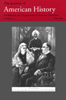
On the cover:
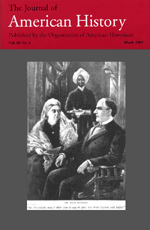
Selling empire and race patriotism. In this turn-of-the-century tea advertisement, Queen Victoria herself invites President William McKinley to partake in imperial commerce and social relations. Reprinted from Ladies’ Home Journal, Oct. 1897. See “Empires, Exceptions, and Anglo-Saxons: Race and Rule between the British and United States Empires, 1880–1910,”; p. 1315
 Full Text

